Skills and Entrepreneurship training for youth and women
So far, HOPE has facilitated the formation of a number of women groups in the Nandom District. These groups form the organizing units for the empowerment activities - skills and livelihoods development in soap making, Shea-butter extraction in commercial quantities, training in weaving and dressmaking. So far, one group has undergone training in soap making and are regularly producing their own soap.
Women participating in soap making during training
Empowering Women through Poultry Production
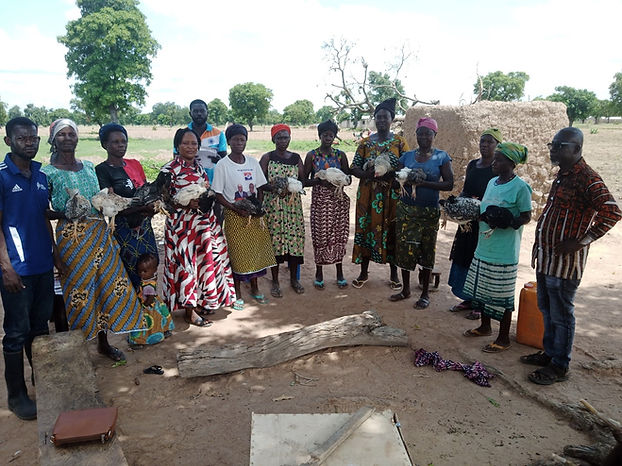
In line with its women economic empowerment, HOPE has embarked on a project to support the women group of Aagureteng to go into poultry production. In June 2022, 11 women received a total of 22 local birds, that is, 2 hens each. All the birds had been pre-vaccinated to protect them from common poultry diseases.
The project is of a revolving nature; each of the women beneficiaries of the initial donation, is expected to return two young hens to HOPE in a number of months when the birds are expected to have multiplied. These will be passed on to another set of women who will also return 2 birds each to be passed on to another set until all 45 women in the group are involved in poultry rearing.
To increase the success of the project, a local veterinary officer from the Ministry of Food and Agriculture is involved to provide technical support. His role is to constantly monitor and coach the women on best practices as well as to provide regular vaccination services for the birds.
Encouraging women to engage in the occupation of poultry production has a great potential to increase households’ access to nutritious foods and higher incomes. As well, the poultry project presents an effective avenue for addressing social and gender imbalances amongst the native Dagara tribe where poultry production has hitherto remained an only male business.
However, as realizing lasting change for women and girls requires confronting the complex factors that limit women especially as women do not customary own productive assets such as livestock amongst the Dagara, the women initially resisted fiercely the idea of engaging in poultry production. It was on grounds that they would be drawing their husbands into conflict it they took the birds home. It took a meeting with their husbands to convince them on the virtues of their wives venturing into poultry production before they issued an explicit permission to the women to take up the initiative.
A key lesson is seen how drawing men into conversations about economic opportunities for women and their trickle down effects on households, can move the needle on achieving social and economic equality.
To the extreme left is the veterinary officer posing with women carrying the birds.
Advocacy/Provision of WASH services and education
The advent of COVID 19 has made the provision of WASH services and education even more critical for communities the World over. But access to WASH services and education is very limited in rural Ghana. Many rural communities still share drinking water sources with animals due to inadequate supply of clean water for domestic uses. Hygiene education is also always lacking. In response to these critical needs, HOPE has designed intervention in WASH that are synergistic with our skills training and livelihood activities.
A notable outcome of the Aagureteng Women's Group Soap-making and Distribution Project was the revelation of access to potable water challenges in some neighboring communities in the Nandom and Lambussie-Karni Districts. In the heat of the pandemic when prevention education was intensified, there were complaints about the lack of water for regular handwashing in some communities. HOPE undertook a survey in selected communities to ascertain the water coverage in the two districts. It was found that some significant number of villages still have difficulties in accessing potable water to the extent that a few were still relying on rivers, ponds and other potentially contaminated sources for their water needs. This state of affairs called for an inclusion of the provision of water and hygiene facilities in the initial livelihood improvement activities. Indeed, the provision of water can be naturally linked to women's empowerment since women and girls bear the brunt of the collection of house-hold water needs. As women and girls child-centred NGO, HOPE recognizes that the ready accessibility of clean drinking water in local communities, is intricately linked to their general well-being.
In the first quarter of 2023, HOPE, with financial support from the Dutch organization, Oasen Water Company, provided two boreholes to the Tampelle-Aagureteng and Guo communities in the Nandom Municipal Area. The water is impacting a lot the general wellbeing of the two communities, particularly on their health, as incidences of water-borne diseases, are drastically reduced.
School Girls fetching water from newly installed borehole @ Guo Community Photo Credit: Dr. Naaikuur
Provision of furniture to selected Schools
Education has always proven to be a very important tool for development in any country. It is considered as one of the major tools for eradicating poverty and preventing ignorance among citizens. Goal 4 of the United Nations (UN) Sustainable Development Goals (SDGs) aims to ensure inclusive and equitable quality education and promote lifelong learning opportunities for all. Goal 4a. underlines the need to build and upgrade education facilities that are child, disability and gender sensitive and provide a non-violent, inclusive and effective learning environments for all.
Many governments across the world devote a lot of attention and resources into the education sector. In Ghana, since independence, various governments have implemented policies to make education accessible to almost every Ghanaian of school going age. Indeed, the 1992 Constitution explicitly states that basic education shall be free, compulsory and available to all.
However, the Ghanaian educational sector is facing several challenges especially in rural areas. It is still very clear that not all communities in Ghana have access to education. A major constraining factor in the educational sector in Ghana is the poor nature of facilities and the lack of conducive environments for learning at schools. The situation is characterized by:
-
Poor classroom and furniture condition in the schools
-
Inadequate textbooks, reading and teaching/learning materials, education and sports equipment
-
Lack of library and computer lab especially in remote areas
-
High rate of female dropout after primary level
Many rural areas across the country are dotted with dilapidated buildings used as classrooms. These buildings rather become death traps which scare pupils and the teachers away from school. Most village schools do not have enough classroom blocks for teaching and learning whilst under trees schools still abound.
One of such deprived schools is the Tampelle KG and Primary school located in the Nandom Municipal Area in the Upper West Region. The school, the only one in the Tampelle community with a population of 166 pupils and 3 teachers, has had a very un-conducive environment for teaching and learning for long time. Amongst other acute needs, there has been no furniture for the teachers and pupils to use. The teachers lamented that due to the lack of furniture to sit on and prepare lesson notes or mark class exercises, they had to spend their free time at home to do school work.
In June 2022, Hope for People’s Empowerment (HOPE) with funding from another NGO, the Vibrant Village Foundation donated 4 tables and 4 chairs to the school. The picture below captures the presentation ceremony of the furniture. The furniture will go a long way to boost the morale of the teachers and to contribute to improved teaching and learning outcomes at the school.
The Executive Director of HOPE, Dr. Lawrence Naaikuur (left) presenting the furniture to some of the teachers and community members at Tampelle.
Citizens Participation in Governance
HOPE believes in the engaging power of communities to demand accountability from duty bearers, but also contribute towards development planning of the local government. To this effect, our activities primarily involve engagement with communities to mobilize themselves into active agencies of development. Apart from calling on duty bearers to demand for the provision of social services and other development projects, communities also mobilize to start development initiatives. While we advocate for the provision of development projects for underserved communities, we also facilitate the initiation of self-help projects, which often get funding support from the local government and other development organizations including NGOs.